
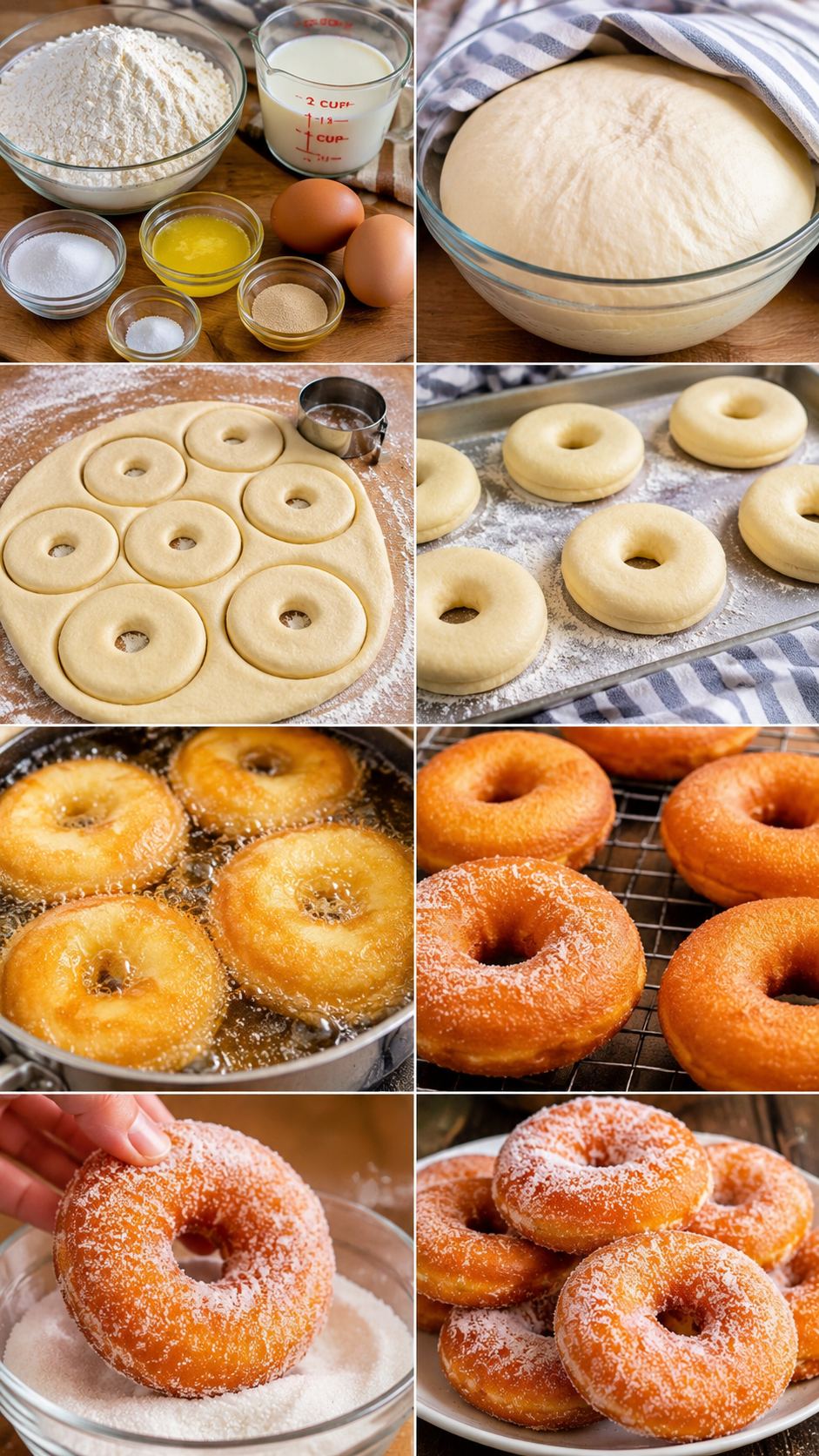
These homemade sugar donuts are everything a perfect donut should be! They’re incredibly soft and fluffy on the inside, beautifully golden on the outside, and generously coated with sweet granulated sugar. Made from simple pantry ingredients, these classic homemade donuts are perfect for breakfast, brunch, afternoon snacks, or a delicious family dessert.
The dough is soft, rich, and slightly sweet, creating a light and airy texture after frying. Once the donuts come out of the hot oil, they’re coated in sugar while still warm, giving them that irresistible sweet finish.
If you love classic American bakery-style donuts, this easy homemade recipe is one you’ll want to make again and again!
Preparation Information
- Preparation Time: 25 minutes
- First Rising Time: 60 minutes
- Second Rising Time: 20–30 minutes
- Cooking Time: 20 minutes
- Total Time: Approximately 2 hours and 15 minutes
- Servings: 12–15 donuts
- Difficulty: Easy to Medium
INGREDIENTS
For the Donut Dough
- 4 cups (500 g) all-purpose flour
- 1 cup (240 ml) warm milk
- ¼ cup (50 g) granulated sugar
- 2½ teaspoons (7 g) instant yeast
- 2 large eggs, at room temperature
- ¼ cup (60 g) unsalted butter, melted and slightly cooled
- ½ teaspoon salt
- 1 teaspoon vanilla extract (optional)
For Frying
– 4–6 cups vegetable oil, or enough for deep-frying
For the Sugar Coating
- 1 cup (200 g) granulated white sugar
- ½ teaspoon ground cinnamon (optional)
For Dusting
– 2–3 tablespoons all-purpose flour
STEP-BY-STEP INSTRUCTIONS
Step 1: Prepare the Ingredients
Before starting, measure all your ingredients carefully.
Warm the milk until it is slightly warm to the touch, around 100–110°F (38–43°C). It should never be too hot because excessive heat can damage the yeast.
Melt the butter and allow it to cool slightly. Take the eggs out of the refrigerator so they can reach room temperature.
Prepare a large mixing bowl, measuring cups, a whisk, and a clean kitchen towel.
Step 2: Activate the Yeast
In a small bowl, combine the warm milk, granulated sugar, and instant yeast.
Stir gently until the sugar begins to dissolve.
Let the mixture sit for about 5 minutes. It may become slightly foamy, indicating that the yeast is active.
If using instant yeast, you can also mix it directly with the flour, but this short resting step helps distribute the ingredients evenly.
Step 3: Mix the Dough
In a large mixing bowl, add the flour and salt. Mix briefly to combine.
Add the eggs, melted butter, vanilla extract, and yeast mixture.
Using a wooden spoon or stand mixer fitted with a dough hook, mix everything until a soft dough begins to form.
Continue mixing until the flour is incorporated and no large dry patches remain.
The dough should be soft and slightly sticky. Avoid adding too much extra flour, because this can make the finished donuts dense instead of fluffy.
Step 4: Knead the Dough
Transfer the dough to a lightly floured work surface.
Knead by hand for approximately 8–10 minutes, stretching and folding the dough until it becomes smooth, elastic, and soft.
If using a stand mixer, knead on medium-low speed for approximately 6–8 minutes.
To check whether the dough is ready, gently stretch a small piece between your fingers. It should stretch without immediately tearing.
Place the finished dough in a lightly greased bowl.
Step 5: First Rise
Cover the bowl with plastic wrap or a clean kitchen towel.
Place it in a warm, draft-free area and allow it to rise for approximately 1 hour, or until it doubles in size.
The rising time may vary depending on the temperature of your kitchen.
Once the dough has doubled, gently press it down with your fingertips to release some of the air.
Step 6: Roll Out the Dough
Lightly flour your work surface and transfer the risen dough onto it.
Using a rolling pin, gently roll the dough into an even sheet approximately ½ inch (1.2 cm) thick.
Try to keep the thickness consistent so that all the donuts cook evenly.
Avoid rolling the dough too thin, because the donuts need enough thickness to become beautifully soft and fluffy.
Step 7: Cut Out the Donuts
Use a round donut cutter to cut out the donut shapes.
If you don’t have a donut cutter, use a large round cookie cutter and a smaller cutter or bottle cap to make the center holes.
Carefully remove the extra dough around each donut.
Gather the leftover dough, gently reshape it, and allow it to rest for a few minutes before cutting additional donuts.
Place the shaped donuts onto a lightly floured baking sheet, leaving enough space between them.
Step 8: Second Rise
Cover the donuts loosely with a clean kitchen towel.
Let them rest for approximately 20–30 minutes, or until they look noticeably puffier and lighter.
This second rise is very important because it helps create that soft, airy bakery-style texture.
Be careful not to let them overproof, as overly risen donuts may collapse during frying.
Step 9: Heat the Oil
Pour vegetable oil into a deep, heavy-bottomed pot.
Heat the oil to approximately 350°F (175°C).
Use a kitchen thermometer to monitor the temperature.
Maintaining the correct oil temperature is important. If the oil is too hot, the donuts may brown too quickly while remaining undercooked inside. If it is too cool, they may absorb too much oil and become greasy.
Step 10: Fry the Donuts
Carefully place 2–3 donuts into the hot oil at a time, depending on the size of your pot.
Do not overcrowd the pot.
Fry each donut for approximately 1–2 minutes on the first side, until it becomes golden brown.
Carefully turn each donut using a slotted spoon or kitchen tongs.
Fry the other side for another 1–2 minutes, until both sides are evenly golden.
The donuts should puff up beautifully as they cook.
Transfer the cooked donuts to a wire cooling rack or a plate lined with paper towels.
Allow excess oil to drain.
Continue frying the remaining donuts in small batches, keeping the oil temperature around 350°F (175°C).
Step 11: Prepare the Sugar Coating
While the donuts are cooling slightly, prepare the sugar coating.
Place the granulated white sugar in a wide, shallow bowl.
If you enjoy a little extra flavor, add ½ teaspoon of ground cinnamon and mix well.
The cinnamon is optional. Traditional sugar donuts are delicious with plain granulated sugar.
Step 12: Coat the Donuts with Sugar
While the donuts are still warm, gently roll each one in the prepared sugar.
Turn them carefully until the entire surface is evenly coated.
The slight warmth helps the sugar stick beautifully to the outside.
For an extra generous coating, gently sprinkle a little additional sugar over each donut.
Place the finished donuts on a clean serving plate or wire rack.
Step 13: Serve and Enjoy!
Arrange the sugar-coated donuts on a beautiful serving plate.
Stack them slightly to create an inviting bakery-style presentation.
For the best experience, serve them while they’re fresh and slightly warm.
When you break one open, you’ll reveal a soft, fluffy, airy interior surrounded by a delicate golden crust and a sweet sugary coating.
These homemade sugar donuts are perfect with a cup of coffee, hot chocolate, tea, or a glass of cold milk.
IMPORTANT TIPS FOR PERFECT DONUTS
1. Use warm milk, not hot milk: Very hot milk can damage the yeast and prevent the dough from rising properly.
2. Don’t add too much flour: A slightly sticky dough produces softer, fluffier donuts.
3. Knead properly: Kneading develops the gluten, helping the donuts maintain their light and airy structure.
4. Allow enough rising time: The first and second rises are essential for a beautiful texture.
5. Maintain the oil temperature: Keep the frying temperature close to 350°F (175°C).
6. Fry in small batches: Too many donuts in the pot can lower the oil temperature.
7. Coat while warm: Sugar sticks best when the donuts are still slightly warm.
8. Use fresh oil: Clean-tasting vegetable oil helps preserve the delicious flavor of your donuts.
STORAGE INSTRUCTIONS
At Room Temperature:
Store completely cooled donuts in an airtight container for up to 2 days. Keep them in a cool, dry place.
Refrigeration:
Refrigeration is generally not recommended because it can make the donuts dry and firm.
Freezing:
For longer storage, freeze the uncoated donuts in an airtight freezer-safe container for up to 2 months. Thaw at room temperature and warm gently before coating with fresh sugar.
Reheating:
Warm the donuts in a microwave for approximately 8–10 seconds, or in a low-temperature oven for a few minutes. Avoid overheating them.
FREQUENTLY ASKED QUESTIONS
Can I prepare the dough ahead of time?
Yes! You can prepare the dough, cover it, and refrigerate it overnight after the first rise. Bring it closer to room temperature before shaping and continuing with the recipe.
Why are my donuts hard instead of fluffy?
This can happen if too much flour is added, the dough is not kneaded properly, or the donuts do not rise long enough.
Can I use active dry yeast instead of instant yeast?
Yes. Use the same quantity, but dissolve it in the warm milk with the sugar and allow it to activate for approximately 5–10 minutes before adding the remaining ingredients.
Can I make these donuts without a donut cutter?
Absolutely! Use a large round cookie cutter and a small round cutter to create the center holes.
Can I use powdered sugar instead of granulated sugar?
Yes, but the texture will be different. Granulated sugar gives these donuts their classic traditional sugar-coated finish.
How do I know when the donuts are fully cooked?
They should be evenly golden brown on both sides and cooked through in the center. Maintain the recommended oil temperature and avoid making the donuts too thick.
FINAL RESULT: Beautiful golden homemade sugar donuts with a soft, fluffy interior, a delicate fried crust, and a generous coating of sweet sugar. A classic homemade treat that the whole family will love! 🍩❤️