
Ingredients
For the Donut Dough:
- 3½ cups (440 g) all-purpose flour
- ¾ cup (180 ml) warm whole milk
- 2¼ teaspoons (7 g) active dry yeast
- ¼ cup (50 g) granulated sugar
- 1 large egg, room temperature
- ¼ cup (56 g) unsalted butter, softened
- 1 teaspoon vanilla extract
- ½ teaspoon salt
- 2–3 tablespoons additional flour, if needed
For Frying:
- 4–6 cups vegetable oil, or enough for deep frying
For the Sugar Coating:
- 1 cup (200 g) granulated sugar
- ½ teaspoon ground cinnamon (optional)
Instructions
Step 1: Activate the Yeast
Pour the warm milk into a small bowl. Make sure the milk is warm but not hot. Add the active dry yeast and one teaspoon of the measured sugar. Stir gently and let the mixture sit for 5–10 minutes until it becomes foamy.
This step helps activate the yeast and gives the donuts their beautiful, light, and fluffy texture.
Step 2: Prepare the Dough
In a large mixing bowl, combine the remaining granulated sugar, egg, vanilla extract, and softened butter. Add the activated yeast mixture and whisk until everything is well combined.
Gradually add the all-purpose flour and salt. Mix with a wooden spoon or dough hook until a soft dough begins to form.
The dough should be slightly sticky but manageable. Avoid adding too much extra flour, as this can make the donuts dense instead of soft.
Step 3: Knead the Dough
Transfer the dough to a lightly floured work surface.
Knead by hand for approximately 8–10 minutes, or use a stand mixer fitted with a dough hook for 6–8 minutes on medium-low speed.
Continue kneading until the dough becomes smooth, elastic, and stretchy.
If the dough feels excessively sticky, add a little flour, one tablespoon at a time. Do not add too much.
Step 4: First Rise
Lightly grease a large bowl with vegetable oil or butter.
Place the dough inside and turn it once so the surface is lightly coated.
Cover the bowl with plastic wrap or a clean kitchen towel.
Leave it in a warm, draft-free place for approximately 60–90 minutes, or until the dough doubles in size.
The rising time may vary depending on your kitchen temperature.
Step 5: Roll Out the Dough
Once the dough has doubled in size, gently punch it down to release excess air.
Transfer it to a lightly floured surface.
Using a rolling pin, roll the dough into an even layer approximately ½ inch thick.
Try to maintain an even thickness so all the donuts cook evenly.
Step 6: Cut the Donuts
Use a round donut cutter to cut out the donuts.
If you do not have a donut cutter, use a large round cookie cutter and a smaller cutter or bottle cap to make the center holes.
Carefully remove the excess dough around the donuts.
Gather the remaining dough scraps, gently knead them together, let them rest for 5–10 minutes, and cut out additional donuts.
Step 7: Second Rise
Arrange the shaped donuts on parchment-lined baking sheets, leaving enough space between each one.
Cover loosely with a clean kitchen towel.
Let them rise for another 25–35 minutes, until they look noticeably puffier and lighter.
Be gentle when handling them so they do not lose their air.
Step 8: Heat the Oil
Pour vegetable oil into a deep, heavy-bottomed pot or Dutch oven.
Heat the oil to approximately 350°F (175°C).
Use a kitchen thermometer to maintain a consistent temperature.
If the oil is too hot, the donuts may become dark on the outside while remaining undercooked inside. If it is too cool, they may absorb too much oil.
Step 9: Fry the Donuts
Carefully place 2–3 donuts into the hot oil at a time, depending on the size of your pot.
Do not overcrowd the pot.
Fry each donut for approximately 1–2 minutes on the first side, until golden brown.
Carefully flip using a slotted spoon or chopsticks and fry the other side until beautifully golden.
Remove the donuts and place them on a wire rack lined with paper towels underneath to catch excess oil.
Continue frying the remaining donuts in batches, allowing the oil to return to the proper temperature between batches.
Step 10: Prepare the Sugar Coating
While the donuts are still warm, pour the granulated sugar into a wide, shallow bowl.
If desired, add the ground cinnamon and mix well.
The cinnamon is optional, so you can keep the coating simple with classic granulated sugar.
Step 11: Coat the Donuts
Once the donuts have drained briefly, gently roll each one in the sugar mixture.
Turn them carefully until every side is evenly coated.
The slightly warm surface helps the sugar stick beautifully.
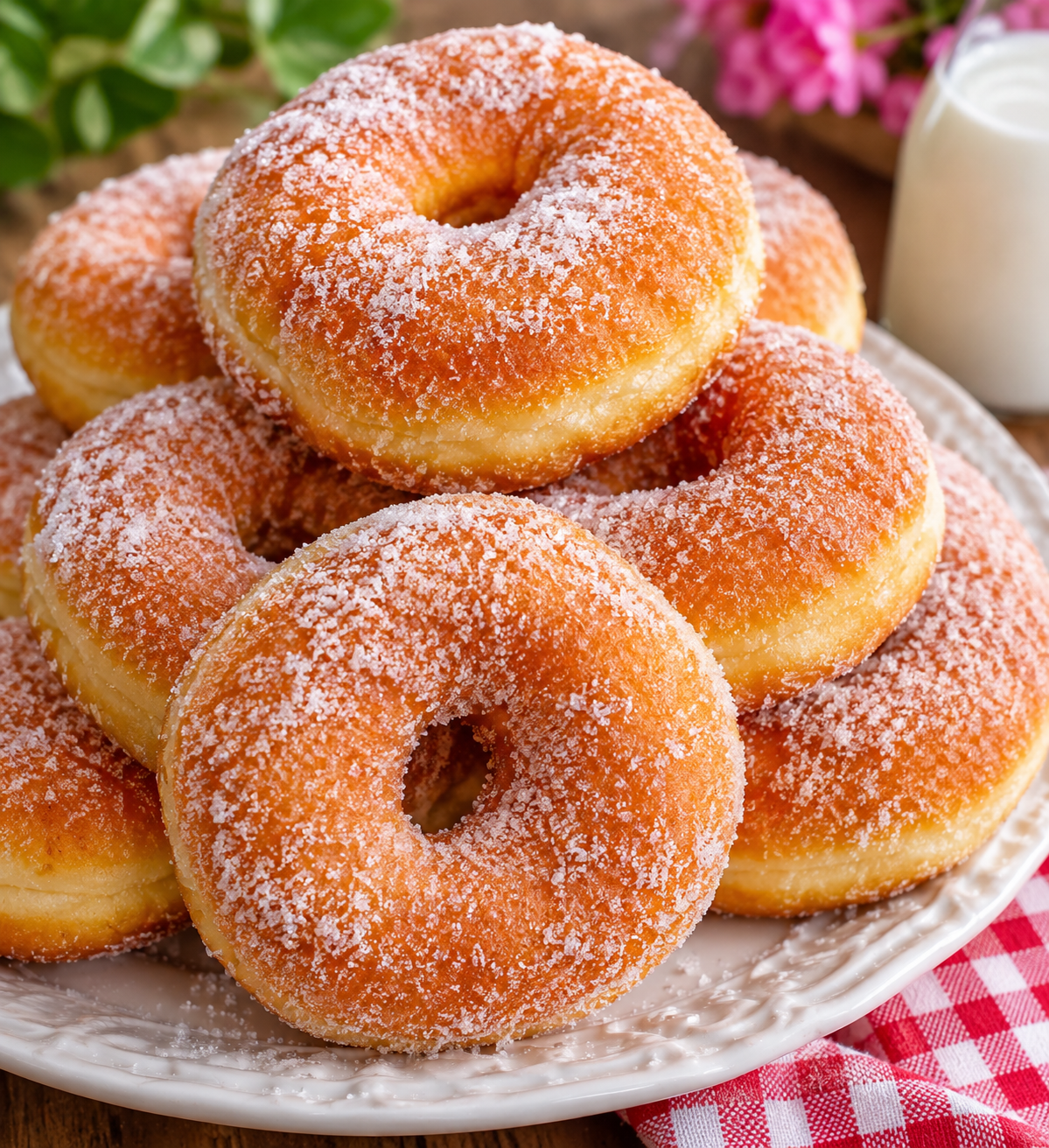
Place the finished donuts on a serving plate or wire rack.
Step 12: Serve and Enjoy!
Arrange the homemade sugar donuts on a beautiful serving plate.
Serve them while fresh and slightly warm, alongside a cup of coffee, tea, or a cold glass of milk.
Break one open and enjoy the incredibly soft, airy interior surrounded by a delicate golden crust and sparkling sugar coating.
Every bite is sweet, fluffy, and absolutely irresistible!
Tips for Perfect Homemade Sugar Donuts
- Check your milk temperature: It should be warm, not hot, to protect the yeast.
- Use fresh yeast: Make sure the yeast activates and becomes foamy before continuing.
- Do not add too much flour: A slightly soft dough produces lighter donuts.
- Allow enough rising time: Proper proofing is essential for fluffy results.
- Maintain the oil temperature: Aim for 350°F (175°C) throughout frying.
- Fry in small batches: This helps maintain the oil temperature and produces evenly cooked donuts.
- Coat while warm: Sugar adheres best when the donuts are still slightly warm.
Storage Instructions
Homemade sugar donuts are best enjoyed fresh on the day they are made.
Store completely cooled leftovers in an airtight container at room temperature for up to 2 days.
To enjoy them again, warm briefly in the microwave for a few seconds to soften the dough.
Avoid refrigerating the donuts, as refrigeration can make them dry and firm.
Yield: Approximately 12–14 donuts
Preparation Time: 25 minutes
First Rise: 60–90 minutes
Second Rise: 25–35 minutes
Frying Time: Approximately 20–25 minutes
Total Time: Approximately 2½–3 hours